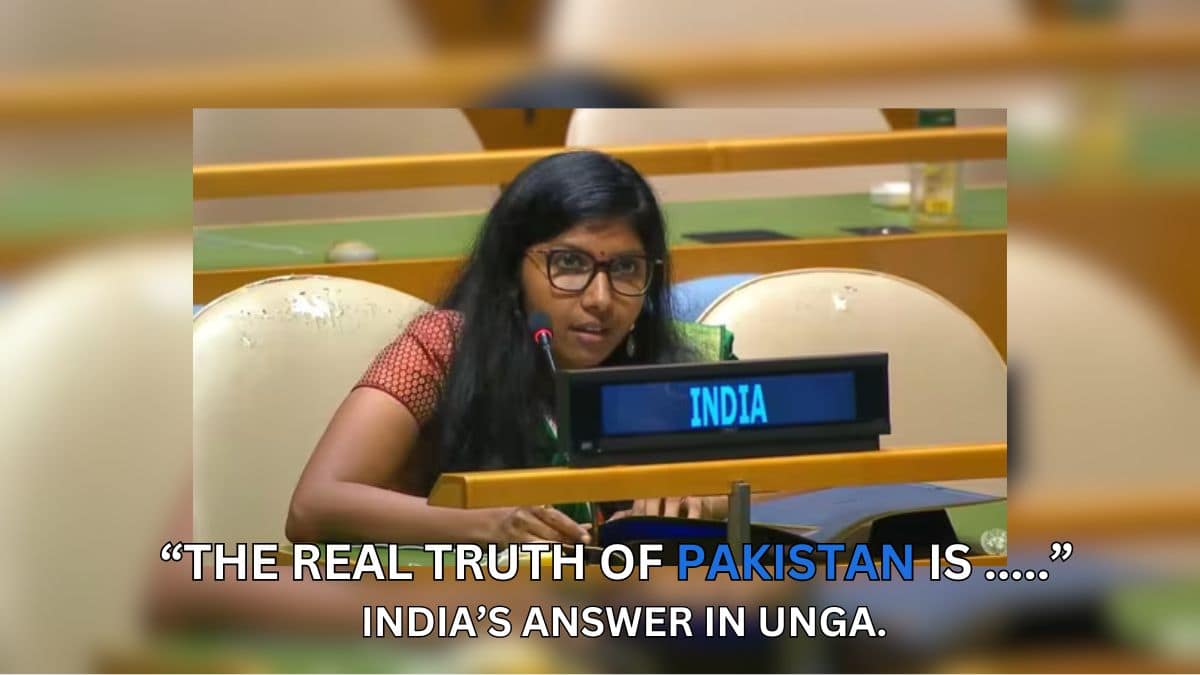
In a firm rebuttal to Pakistan’s repeated attempts to internationalize the Kashmir issue, India delivered a sharp response at the 79th session of the United Nations General Assembly (UNGA). Exercising its Right of Reply, Indian diplomat Bhavika Mangalanandan called out Pakistan’s “audacity to attack the world’s largest democracy” while itself being notorious for cross-border terrorism and political instability. This exchange comes in response to Pakistan Prime Minister Shehbaz Sharif’s provocative comments on Kashmir during his UNGA speech.
Sharif, in his address, accused India of military expansionism and aggression, while once again raising the abrogation of Article 370—a domestic constitutional decision taken by India in 2019. He demanded that India reverse its decision and cease what he described as the “subjugation” of Kashmir’s Muslim population. However, India’s response was both scathing and well-founded, pointing to Pakistan’s historical use of terrorism as a foreign policy tool.
Pakistan’s Track Record of Cross-Border Terrorism
Mangalanandan didn’t mince words in her rebuttal, drawing attention to Pakistan’s long-standing role in sponsoring terrorism against India. “For a country that has attacked our Parliament, financial capital, and pilgrimage routes to lecture about violence is hypocrisy at its worst,” she stated. India reminded the global community that Pakistan has systematically used cross-border terrorism to disrupt elections in Jammu and Kashmir, even as it attempts to portray itself as a champion of democratic values.
This accusation is not new. India has, for decades, faced the brunt of terrorist activities emanating from Pakistani soil, a fact that has been acknowledged globally. Pakistan’s dubious relationship with terror organizations, including those responsible for the attacks in Mumbai, Pulwama, and Uri, has consistently undermined its international credibility. And yet, Pakistan continues to push a narrative of victimhood on the Kashmir issue, often drawing flawed parallels with Palestine—a comparison that neither reflects reality nor resonates with the international community.
A Legacy of Rigged Elections and Political Instability
Pakistan’s lecturing on democracy was met with a strong reminder of its own political instability. Mangalanandan noted that a country with a history of rigged elections and military coups cannot credibly comment on political choices made by a stable democracy like India. Pakistan’s political system, where the military continues to wield outsized influence, has long been viewed with skepticism by the international community. For such a state to demand “self-determination” for Kashmiris rings hollow, especially when it has failed to ensure the same democratic rights for its own citizens.
India’s position on Kashmir has always been clear: Jammu and Kashmir is an integral part of its sovereign territory. The abrogation of Article 370, which granted special status to the region, was a constitutional and internal matter, not subject to external influence or debate. Pakistan’s attempts to interfere in this matter, while continuing to sponsor terrorism, only serve to highlight its desperation on the world stage.
Pakistan’s Kashmir Obsession: A Distraction from Domestic Failures?
Pakistan’s consistent focus on Kashmir at international forums like the UNGA could also be seen as a distraction from its domestic challenges. Faced with economic instability, political chaos, and a deteriorating security situation, the Pakistani government’s obsession with Kashmir provides a convenient distraction. However, the international community, especially in recent years, has grown increasingly weary of Pakistan’s one-note foreign policy agenda.
India’s rejection of Pakistan’s claims reflects a broader fatigue with these repeated, baseless assertions. As Mangalanandan aptly pointed out, “The real truth is that Pakistan covets our territory,” and its attempts to internationalize the Kashmir issue are nothing more than a facade for its deeper, unspoken ambitions. By focusing on Kashmir, Pakistan seeks to divert attention from its own internal issues and its failure to curb terrorism within its borders.
A Clear Message to the World
India’s response at the UN was not just a rebuttal to Pakistan but a message to the global community: terrorism and diplomacy cannot coexist. As Pakistan continues to propagate a false narrative about Kashmir, India will remain steadfast in its commitment to defending its sovereignty and ensuring peace in the region. The world has increasingly recognized Pakistan’s role as a state sponsor of terrorism, and its rhetoric at the UN will not change that reality.
In conclusion, India’s decisive response serves as a reminder that democracies will not be bullied by states with a history of harboring terrorists. The international community must look beyond the rhetoric and recognize the real issues at play—chief among them, Pakistan’s continuous interference in India’s internal matters through the promotion of violence and terror.